Choosing (and Trusting) an At-Home Body Composition Scale
A practical guide from Dr. Jen Case
If you've ever stepped on a smart scale, seen your "body fat percentage," and then stepped on it again five minutes later to see a different number, you're not imagining things, and you're not doing anything wrong. Here's what's actually going on, and which devices are worth your money.
The Short Version
Home body composition scales use a technology called bioelectrical impedance analysis (BIA). A tiny, painless electrical current runs through your body, and the resistance it meets is used to estimate fat, muscle, and water. It's a genuinely useful tool for tracking trends over time. It is not a diagnostic-grade measurement, and it's not meant to compete with a DEXA scan.
Think of it like a bathroom thermometer versus a lab blood panel. Both give you real information, but they're answering different questions.
What the Research Actually Shows
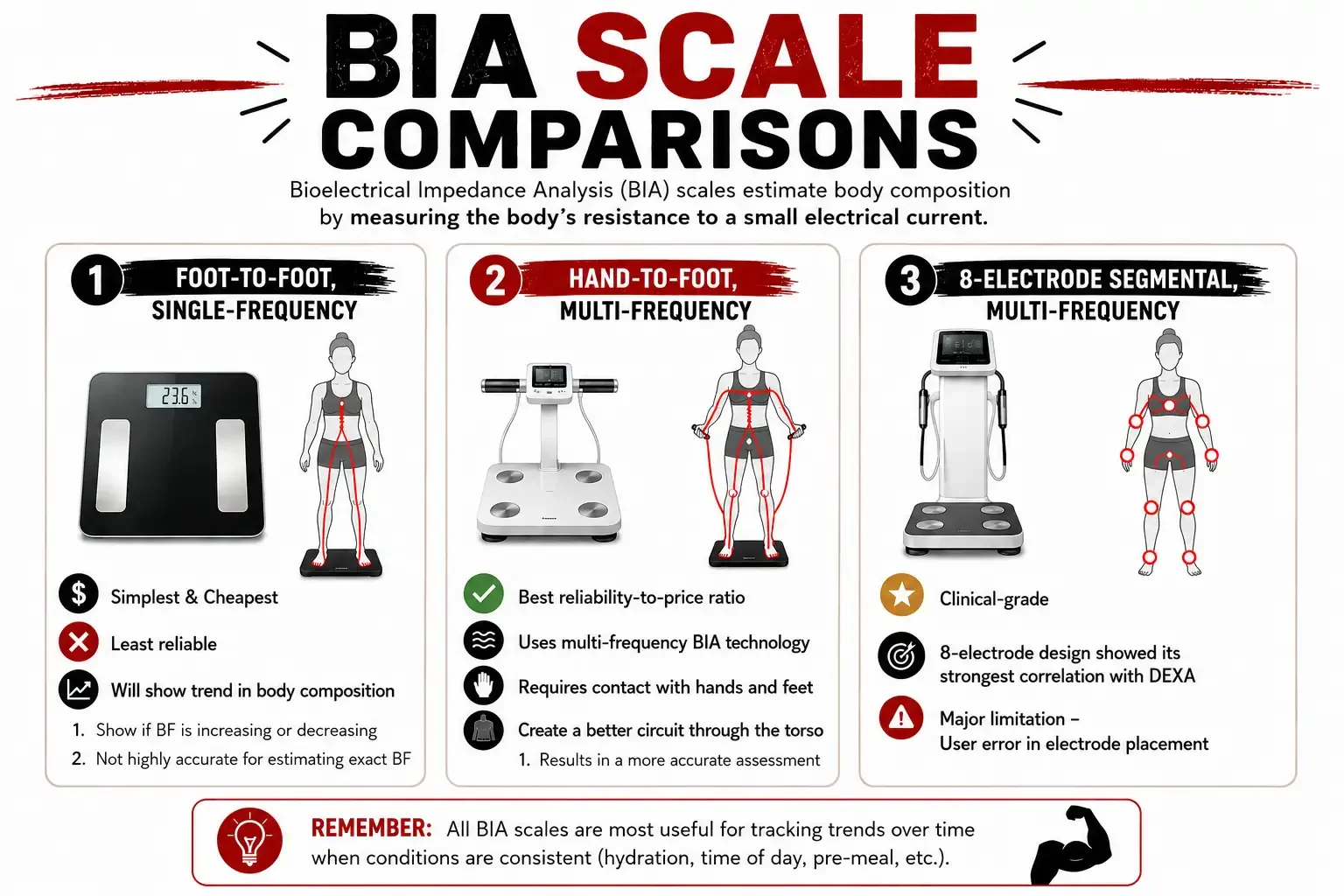
Not all BIA scales are created equal. While they all estimate body composition by measuring how easily a small electrical current travels through your body, the technology they use can have a significant impact on accuracy.
The most basic option is the foot-to-foot, single-frequency BIA scale, which is the type most commonly found in bathrooms and big-box stores. These scales are simple to use and typically the least expensive. While they are the least accurate of the three technologies, they can still be useful for tracking changes over time. If your body fat percentage is consistently trending downward (or upward) under similar testing conditions, the scale is likely capturing a real change, even if the exact body fat percentage isn't perfectly accurate.
A step up in both technology and performance is the hand-to-foot, multi-frequency BIA analyzer. These devices require you to maintain contact with electrodes on both your hands and feet, allowing the electrical current to travel through a much larger portion of the body, including the torso. They also use multiple electrical frequencies, which improves the estimation of body composition. In my opinion, this type of device offers the best balance between accuracy and cost, making it an excellent choice for most athletes, fitness enthusiasts, and health professionals.
The most advanced option is the 8-electrode segmental, multi-frequency BIA analyzer. These systems are often considered clinical-grade because they use eight separate electrodes to measure each arm, each leg, and the trunk independently. Research has shown that this design demonstrates the strongest correlation with DEXA, making it one of the most accurate forms of BIA technology currently available. However, these devices are not without limitations. Because they rely on precise placement and consistent contact of all eight electrodes, user error can negatively affect the accuracy of the results. Even with this limitation, they remain the gold standard among commercially available BIA devices.
Popular BIA Scale Brands
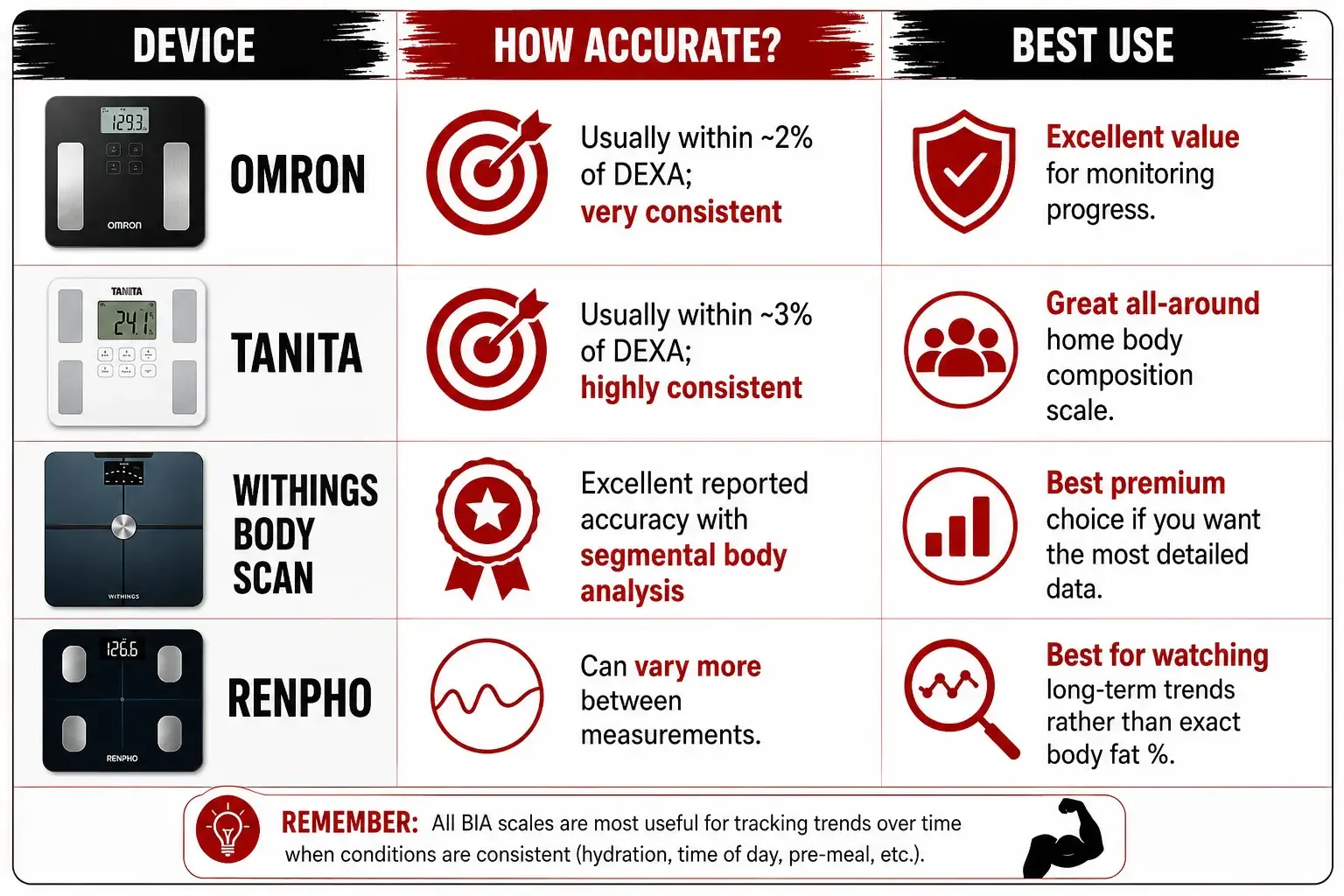
Among the more affordable options, Omron scales have consistently demonstrated good precision and relatively low error when compared with DEXA scans. They may not provide a perfect estimate of your body fat percentage, but they are a reliable and budget-friendly choice for tracking changes over time.
Tanita scales are another solid option. They typically show slightly greater error than Omron devices, but their measurements are very consistent from one test to the next. Because consistency is often more important than absolute accuracy when monitoring progress, Tanita remains one of the most trusted and widely available home body composition scales.
If you're looking for a premium option, the Withings Body Scan offers some of the most advanced features available for home use. In addition to strong reported accuracy, it provides segmental body composition analysis, allowing you to evaluate your arms, legs, and trunk separately. This makes it an attractive choice for athletes, individuals recovering from injury, or anyone who wants more detailed information about their body composition.
On the more budget-friendly end, Renpho scales can still be useful, but they tend to show greater variability between measurements. Rather than focusing on the exact body fat percentage displayed, these devices are best used to identify long-term trends. If your body fat percentage gradually decreases over several weeks or months under consistent testing conditions, the scale is likely providing useful information, even if the exact percentage isn't perfectly accurate.
Ultimately, the most important factor isn't which brand you purchase; it's how consistently you use it!
The pattern that matters most: every home BIA device tends to run a few percentage points off from DEXA in one direction or another. This is expected and normal, it doesn't mean the scale is broken.
How to Actually Use Your Scale
Weigh yourself at the same time of day, under the same conditions. Ideally, first thing in the morning, after using the bathroom, before eating or drinking, minimal clothing.
Track the trend, not the day. One reading means very little. Four weeks of readings that have been averaged out tell you something real.
Expect noise around your cycle and during perimenopause. Hydration status shifts BIA readings independent of any actual change in your body. Hormonal fluctuations (ie different stages of your menstrual cycle) affect hydration. A "jump" in body fat percentage overnight is almost always water, not fat.
Don't test right after exercise, sauna, alcohol, or a high-carb meal. All of these change your hydration status and will skew the reading.
Use one device consistently. Switching between scales (or between a scale and a DEXA scan) will show you different absolute numbers because each device uses its own estimation formula. Comparing across devices is comparing apples to oranges.
What NOT to Do With These Numbers
Don't panic over a single day's reading
Don't compare your number to a friend's number from a different scale
Don't use it as your only measure of progress. Also consider how your clothes fit, your strength numbers, your energy, your sleep and recovery, etc.
Don't chase a "perfect" body fat percentage number pulled from the internet. Focus on a percentage that is right for you based on lifestyle, training, individual physical characteristics, etc.
Bottom Line
A home BIA scale is a useful piece of the puzzle, not the whole picture. Used consistently and interpreted as a trend tool, it can help you see real patterns over weeks and months. Used as a daily verdict on your body, it will mislead you and mess with your head.
If you want a more precise one-time snapshot, a DEXA scan is worth the investment periodically. For week-to-week tracking, a consistent, well-reviewed home scale like Tanita or Omron is a solid, affordable choice.
Questions about which device fits your goals, or how to interpret your own numbers? Reach out — this is exactly the kind of thing we work through together in coaching.
Dr. Jen Case, PhD, CSSD, RD, CSCS Case Complete Nutrition & Fitness